

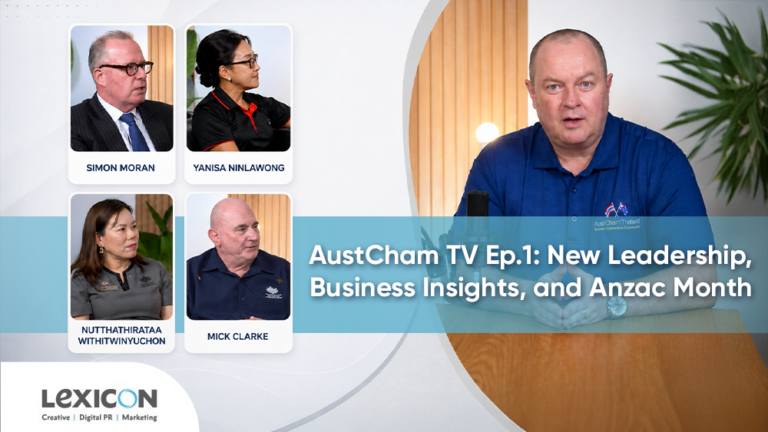
Brendan: Welcome to AustCham TV. We’re back. And we’re back by popular demand to bring you updates from the Australian Thai business community at Lexicon’s Bangkok Podcast Studio.
Coming up in this episode, we welcome the new AustCham president, Simon Moran. He’s going to tell us about his vision and plans for 2026. In connections, we meet an Australian success story, 20 years of ANCA CNC Machines and in the community section, April is Anzac Month from Hellfire Pass Interpretive Center. We’ll talk about Anzac Day Dawn services this year. Stay tuned. Welcome back. As you’d all be aware, AustCham recently held our annual general meeting. We elected a new board and very importantly, we elected a new president. For our business section today, we welcome that new president, Mr. Simon Moran. How are you?
Simon Moran: Very well. Thanks, Brendan. Sawadee kub.
Brendan: Sawadee krub.
Simon Moran: Good to be here.
Brendan: Great. And newly elected president. Firstly, congratulations.
Simon Moran: Thank you, thank you.
Brendan: It’s great to have you on board and great to be working with you over the next 12 months at least.
Simon Moran: Yes of course.
Brendan: So I’m excited. I know of course, quite a lot a bit about you already, but for our members or who also know you as well, but who don’t know you as deeply as with a lot of us do. Tell us about yourself.
Simon Moran: Okay. Born and bred in Melbourne, Victoria, Australia, and I came to Thailand 26 years ago to Greenfield start an auction business which put me in touch with nearly all the banks, the finance companies, insurance companies, rental companies, motorbike companies, salvage companies, anything with wheels we we dealt with. And that was actually an American company. And the American company sold that company to me, and I rebranded that about six years ago with some co-investors. And then we sold that business about one year ago, a year and a half ago, I think. So that’s led me to now run my own. And to take over for my father, some family operated businesses, but it’s left me a lot more time professionally. And I’m not traveling nearly as much to be able to spend a lot more time on AustCham issues, which I’m really looking forward to. It’s been a pleasure so far, and we’re only two weeks in. Excellent.
Brendan: You’ve been busy for the past two weeks. I’m fully aware. Your introduction into Thailand, you were also able to meet corporate training providers, I believe.
Simon Moran: I was. You are in the very early days to help. Thank you very much. Actually, that’s something I’ve overlooked. But we we used you to help out with some training of our staff and particularly the English skills which helped them get along with the progression of their career. And for us to be able to communicate very quickly in the business as an English speaking business and a foreign business, really important to have those skills come up. And our staff are very thrilled to be able to learn more.
Brendan: Excellent. Now, you touched immediately on your business journey here with the first company, and then rebuying the company yourself and then being able to sell that off over 25 years here in Thailand. There’s a lot more things that have been packed into those 25 years. Can you tell us what else you’ve been doing outside of those business interests?
Simon Moran: Well, really, contributing to Thailand through philanthropic events, a lot of work with orphanages and stuff like that. But I have to say, a lot of it was really business based in the early days. It was a lot of offshore stuff as well, right up until about 2018. So that kept me very, very busy with a very large staff and just working hell, hell for leather to grow the business as quick as we could and as big as we could to really make a difference with what we were doing. A lot of travel around Thailand, a lot of people sort of stick to the cities, but you really should get outside and see Chang Wat, see the up country parts of the country. It’s very illuminating and it’s quite educational to get out there and to really touch base with the true Thailand.
Brendan: And speaking of true Thailand, you’re a true Thai.
Simon Moran: I am.
Brendan: You’re a Thai citizen, I believe.
Simon Moran: Yes, Thai citizen. After a long wait, it’s a long process, but it’s worth it. You have to be very patient through this. I must say, the government services through this are actually fantastic, even though it takes a very long time. But that’s left me open to some more opportunities within the country to help other businesses perhaps, and to look at their businesses and see what they’re doing and how we can make them more efficient. I should say that having worked in an auction company, we got to clean up a lot of mess that people got themselves into financially or operationally with their assets. So we had to help clean up some of those messes. And if you sort of think about it in hindsight, uh, the more hindsight that you have to look through, the less mistakes you probably make in the future. So I have a pretty big book of hindsight that’s jammed back full of mistakes, me included.
Brendan: I was wondering, could you share what was probably one of the biggest mistakes you’ve ever made? And so one of the best lessons you’ve ever learned.
Simon Moran: Biggest mistake. Brendan, let me think. I think it might be that I came here in the year 2000, and we had Thaksin as a prime minister. The environment was very promising and everybody expected a lot from this. But one of the things which dawned on me after about a year or two, was that my Thai language skills were just not up to scratch. And a lot of businesses are based on relationships. It’s really hard to have a meaningful, trustful, enthusiastic and driven relationship with a customer or a client if you can’t communicate with them properly. So it’s one of those sacrifices you might have to say, well, I have to give up an hour of my time on Saturday or an hour of my time between 6 and 7 p.m. every day. Get a Thai teacher. Start learning the vocabulary. Start learning the spelling. Because once you learn the spelling, you’ll understand that maybe you’ve been saying that word wrongly for about 20 years. So learn the language and communicate really well. I think some SME outtakes were for me that I was very fortunate. I worked for a very large American company with very deep pockets in terms of legal advice. So we never had any major issues with shareholder agreements with the construction or with the constitution of the board. And we never had any issues in terms of authority levels. But if we think about it in terms of an SME, you might say, I’ve got a fantastic idea and I’m going to go in business with my buddy, and you never really do a proper shareholders agreement. You never really think about what will happen if one of you has a health issue or a communication issue, or a travel issue, or any other kind of issue that might come up.
Brendan: Empathy, really.
Simon Moran: There could be anything. It could be that you’re stuck in Australia like I was when we had the airport closure. It was a marathon trip to get back. What it taught us about that was we need to be a bit more permissible with some of our bank or banking authorities. So that was one on top of another one. That was one of the issues that we learned. So I think for small businesses that are starting up here, make sure you get your ducks in a row with your shareholders agreement, your the constitution of your board, what you’re allowed to do and what you’re allowed allowing other people to do with your money. We know a lot of people who operate sort of a bit more freely here because it’s not so much their money, but when we’re talking about SMEs, it is your money. And you would probably do things a bit differently if it was your money. So knowing that it is your money, put the work into how you set that up from the beginning so that you can grow. You can be ready to be taken over if someone puts an offer to you. You can be ready to sell. You can be ready to close down if you absolutely had to. So there’s any number of alternatives that can happen in that sort of system, but it’s worthwhile getting that done properly at the beginning. And then there’s really very few arguments and you should be able to trust each other.
Brendan: Interesting. And I did have a snapshot into that in the recent SME coffee that we both attended, and fellow members were sharing ideas about some of the problems and issues they were dealing with. And I remember sitting and listening to your feedback sharing like “here’s what you need to consider,” “here’s what I’ve done before,” etc. And I did see quite a few of the members get their pen and paper out and intently looking at everything, which is great.
Simon Moran: It’s a really, really valid point because a big majority of our membership is SMEs and it’s very easy to make some big mistakes very early that can be very expensive and very time consuming to actually fix. If you’re called to fix those issues, some of the things you just don’t even imagine would ever happen, but they do end up happening and you need to be prepared for that stuff. So those SME coffee mornings are really vital as a method of communication for people who are on very similar ground financially and from an effort standpoint. It’s really good that they communicate and they get down to some high protein issues which will help protect them and protect them now, but into their future as our as our market changes. And there’s no better time than right now actually, if we think about what’s happening presently. So the present day is the whole oil issues which we still are yet to see some consequences of. So I think one of the activities of the chamber will be to make sure that we can get some better information out to SMEs about what’s happening currently and what could be happening into the future, so that people can make some plans.
Brendan: Good. And I know that is one of your plans for the chamber in general, and in terms of grabbing your time and other senior business leaders like yourself, the SME coffee is obviously a good place to do it. But for our SME members, we also have other events like Sundowners and industry events we have planned. So for members looking for advice, that’s what the Chamber of Commerce is. Find our Sydney senior business leaders with that experience. As you said, from having made those mistakes already. People can learn from yours.
Simon Moran: I certainly learned a lot the last time we had floods, two coups, floods in Hat Yai, earthquake in Thailand, earthquake in Japan. They’re all serious issues for businesses to face. And the more that you can talk to your fellow compatriots about how you handle some of those things, you’ll get some ideas and some concepts that you can put into play that can help protect you or even grow sometimes.
Brendan: Okay, let’s move on and talk about the plans for this year. So I know you’re only two weeks in the seat, but you’ve been very busy planning already. What are some of the things AustCham members can look forward to in 2026?
Simon Moran: Well, there’s certainly a huge litany of of events that we’re looking at, but the board is also going to spend some time examining what it means to be a member. And the value that you get from that. And looking at ways that we can leverage that up. In particular, we want to talk about what’s happening with our sponsors, our events, our costs. So there’s a cost reduction. So there’s a fair few things on the board’s agenda to get through in terms of short term and then moving into medium and moving into long term as a series of goals. So we’re going to work through start working through that very soon because we need to get some goals on the board pretty quickly and to work towards getting us to be more commerce orientated and to give people opportunities to help them with their business. At the end of the day, people want to have food on the table, maybe a little wine. And the only way you can do that is if you’re if you’re making money through your business and you’re settled and you’re happy and you know where you’re going. So that’s what we would never endeavor to do.
Brendan: Okay, great. And for the members who are looking to engage with AustCham over the next year, how can they get involved?
Simon Moran: A number of avenues we should talk about this. One of my fundamental things is just “show up”. Show up means a little bit like an Australian sort of approach to it. It Means get into the game, stop calling things from the stand, get on the court, grab your racket and have a go. And so that so that to me means show up for your customers, engage with them, talk to them, ring them. Ring them and find out what they’re doing and what they don’t like and what they like. Show up for your for your staff and for your managers and your business. Meaning look after them and support them, especially in times like now. Show up for your shareholders, meaning give them the value that they need and talk to them about why you might not be able to do it. People don’t like surprises. So show up for the conversation and be honest and show up for yourself. Meaning show up to the gym. Show up and do the time on the treadmill. Do the time and the with your food and look after yourself. So by saying “show up”, I mean put the effort into these things. So one of the things we might say is show up to sundown, show up and be there for the people who might just want to have a beer, but also be there to talk about your business and how you might be able to get some business from other people, or how they might be able to do business with you. These are vital things that the chamber’s been famous for for decades. And that’s what we really want to protect and enhance.
Brendan: I think the show up approach goes beyond the dealing business as well, doesn’t it? I know when I’ve many times I’ve maybe not had energy to go to an event. I’m already booked. Do I have energy to go? I’m going. I need to show up. And the amount of times I’ve gone home, maybe not with a potential invoice in my hand, but I’ve learned something. Somebody has told me something at an event, or I’ve met somebody new who I know is going to be a good long term contact. I’m sitting in the taxi going home thinking, if I didn’t go tonight, I wouldn’t have met that person. That person wouldn’t have told me that thing. So it’s just I couldn’t support that more. It’s just so vital to just show up, even when you don’t have the energy to do it, find the energy to do it.
Simon Moran: Sometimes you have to make your own luck, and sometimes things happen, which are out of our control, which can turn into opportunity, or they can turn into something that you may not have handled that well. The more you talk to your friends and your compatriots about what’s going on, the more you’ll find out that, well, actually, maybe I’m doing okay and maybe I need to put some effort into these things and people will share. They will share at these events. So come along to Sundowners, come along to the briefings which are offered before Sundowners. There’s a very important one coming up with Meinhardt talking about data centers. And so we’ve got Meinhardt and Siemens coming. So they are the two powerhouses in terms of what you need in a data center apart from electricity. So I think that conversation will be really important and it will be really interesting. We should look to learn a lot from that.
Brendan: We will then. So that’s on April 1st, 5:00 at SO/ Bangkok, the business briefing featuring Meinhardt. And they have a guest coming along from Siemens talking about data centers, followed by the April Sundowners, 6:00 at SO/ Bangkok on the 1st of April, in Sathorn.
Simon Moran: Yes.
Brendan: At Sathorn. That’s the one. Great. So that’s how people can get involved. How do they join for people who are new to AustCham? If they want to join the chamber, how do they do that?
Simon Moran: The first port of call is get on the internet and look up AustCham. You can email Frank, who is our executive director, or any one of the board members. Then failing that, come along to Sundowners and introduce yourself, or put yourself forward to one of the board members. I’m sure they’ll be very happy to interact with you directly and engage directly, and to get you on as a member. And then we should look to say, well, how could you contribute more? And I know that we’ve got such a depth of fantastic Australian businesses and executives here, and it’s time to put your hand up and to help out your community, get involved with the subcommittee and start to make some effort to achieve the outcomes that the chamber actually needs right now. No better time to be involved because things could be quite challenging as we look forward for the next three to four to six months. If we look at how the Thai economy is constituted in terms of tourism, we could have a few challenges coming with this oil issue. So we need ways to be able to come together and to look at solutions and to make things happen for each other.
Brendan: Great. So really put that due diligence in probably a little more detailed than you’d originally planned. And also, as we talk about reach out to other people in the Chamber of Commerce.
Simon Moran: Absolutely.
Brendan: Who have got those experiences, who have learned their lessons and just really asked for that advice and obviously take that advice as well. Great. So if you would like to contact the chamber, you can first port of call is Frank Hauser, our executive director. His email is just popping up on the screen now. Or connect with him on LinkedIn. We have Simon Moran and Brendan Cunningham. Reach out to us on LinkedIn as well, or simply on the 1st of April. The best advice you’ve given: what should people do on the 1st of April?
Simon Moran: Come to sundowners. Come to the briefing, book your ticket online. It’s very easy. It’s not expensive, and you’ll stand to learn a lot and catch up with some friends or make some new friends. Reach out. Don’t be worried about fear of failure, all that sort of stuff. Put your hand forward and introduce yourself and enjoy.
Brendan: Excellent. Great. Simon, thank you so much for your time. I look forward to working with you and being part of a very successful chamber over the next year.
Simon Moran: Thank you Brendan.
Brendan: And welcome back. In our connection section today, we welcome a long standing and trusted supporter of AustCham for many years from ANCA CNC Machines. We have the general manager of Thailand, Miss Yanisa Ninlawong. Khun Yanisa, how are you?
Yanisa Ninlawong: I’m good. Great.
Brendan: Excellent. Always a pleasure to speak with you. One of my highlights late last year was attending the 20th year anniversary of ANCA in Thailand. It was a great day. We were proud to be part of it. How special was it for you?
Yanisa Ninlawong: For me, it’s a truly very special milestone for all of us. The 20-year celebration was not just about ANCA as a company, but also really about the people and the partnerships that make it possible. We also brought together our teams, our customers, our government representatives, and partners from Australia and Thailand. We made the event even more meaningful.
Brendan: Right? And it did have that feeling to it. The ANCA staff there felt really proud. You could feel it walking around with big smiles on their faces. Very welcoming to everyone. But also, as you mentioned, the partners, which is clients, suppliers, vendors, people from Australia, the government, Australian government partnerships. You had a real feeling that everyone felt proud to be there.
Yanisa Ninlawong: I will say so because in that event, we use celebration as an Australia–Thailand Investment Showcase, which is, I think, at that time around eight companies that participated with us.
Brendan: Yeah, proud to be.
Yanisa Ninlawong: There as well. Yeah. So I think the event went very well. And then it’s more about showing that the collaboration between Thailand and Australia. We have more investors come to Thailand and have success with the Australian companies that are in Thailand.
Brendan: The presentations also echoed that sentiment. The presentations from the founder and the CEO. The way they spoke about how important Thailand was not only as a business, but, like you mentioned, the people, they really spoke about how proud they were of the team in Thailand as well. So let’s go on with that because, you and I speak quite a lot about various topics. And one of the things we often speak about is people and the importance of people in an organization. You touched on it a couple of times. Then 20 years of success has largely been based around the people. How do you get the best out of people at ANCA?
Yanisa Ninlawong: For us, we keep developing people, and then the first thing we create is the trust, and then continue development training on people, and make people possible to grow in their careers. We also invest a lot in training. We have the apprentice program for skills training. It’s a four-year training program, which is how we collaborate with local Thai universities and technical colleges to build the future of engineers and technicians for Thailand.
Brendan: Good. From memory, quite a lot of other organizations are, I guess, a little jealous of what you do. Jealous isn’t the right word. But you often have both government and other companies asking you about how that program is run because it’s considered a best practice and they would like to, to be able to emulate it.
Yanisa Ninlawong: We start this program. Actually, this program is in Australia, we write down the curriculum by ourselves which is this four year program. The first year is we sit in the classroom and the module that is around seven modules is about the safety, the basic safety, the mechanicals and you know, all that. And then the second year to the fourth year that they being on the job training and then we rotate to the different departments to build up that skill. So actually, we are quite successful with this program. Because the apprentices who graduate from us now travel the world. I would say we have the branch. Actually, the first success is when they worked in Australia for six months on a project, and the feedback from Australia was that they could recognize the skills of the Thai apprentices. Then since then, we have the German branch, where one of the apprentices also worked over there for three months in the Europe branch.
Yanisa Ninlawong: So it’s quite successful. And then,the team also very proud of what they doing. The skill that the company invest in developing them in the technical skill for them. When we have the customer or some other company visit us, they see, they thought it’s one year program. Normally like other company, they do only one year programs. But for us it’s four years. It’s very deep technical skill. It’s not just that, we also build them in terms of soft skills as well. We have one of our employees, a master, who’s been in Australia for one year to look after this program, to teach the way that apprentice masters in Australia look after the apprentices, more on analytical skills and problem solving, and also they guide them in their daily life, how to live. So it’s the student.
Brendan: Yes. The older and more experienced we get more experience better than older. The more we often look at the as our staff, as, as an extension of the family as well.
Yanisa Ninlawong: And our apprentice master in that day for the celebration, he cried. He is still proud of what he sees because he started from an operator.
Brendan: And he’s grown, and then he’s helped others to grow as well.
Yanisa Ninlawong: Correct. Correct.
Brendan: What I find really interesting is over that 20 years, you were there at the beginning, 20 years ago. And from what you’ve told me before, there were only 20 employees. Very small team. And then over that 20 year period, grown to 250 employees and very interestingly, gone from one site to another, doubling in size and then tripling in size up to 500 square meters now. If you could give our AustCham members advice, if they’re scaling a business like ANCA CNC Machines has done, what’s the one most important thing you would tell them they need to do?
Yanisa Ninlawong: Okay, what I will say that you need to clearly communicate to the whole title team for them to see the vision, the plan, the strategy of the company, that we will, how far we will go. And then we ask the commitment that, here, this is, are you going to take this commitment? And also, it’s not just about the company it’s growing. It’s about their career also. It will be growing with the business also.
Brendan: Okay. And how are you doing that? Is that at the quarterly?
Yanisa Ninlawong: Quarterly? Yeah, quarterly town hall, or every time there’s going to be a change, a big change. Just talk to them, communicate to them so they know like, you know, similar time that like now when we know also.
Brendan: And in terms of getting that buy-in, that commitment, it’s a question: are you on board? What’s the typical response?
Yanisa Ninlawong: Yes. Let’s go. Let’s do. We can do. The Starbucks is the whole title. I will say the whole title team. Yes. We can. Let’s do it.
Brendan: It’s interesting what you were just mentioning about the soft skills, problem solving, being analytical. We’ve recently been speaking about the concept of think out of the box and with the world being a different place at the moment, you have a little bit of a different spin on think out of the box. Can you share that?
Yanisa Ninlawong: I’m okay with that one. Really, to start with, I have the chairman, the new chairman, visit us early this month. And in the presentation, he asked a lot of questions. But actually, they were coaching questions, and it made me think more that it’s not just about thinking outside the box. What happens if you think outside the box when the box is upside down? And then when I mentioned that to you the other day, you were just laughing. And then you said, yes, that’s what I think, because at the moment the environment keeps changing, the speed of AI, the disruption, it’s all happening. For me, what I feel is the box is upside down. How are you going to think in that environment?
Brendan: So think outside the box, but keeping keep in mind that that box is now spinning with AI disruption. The current geopolitical factors, etc..
Yanisa Ninlawong: A lot, really, you need to rethink and redo things. You can’t do it the old way. Everything is starting new again.
Brendan: And constantly be doing that.
Yanisa Ninlawong: Exactly.
Brendan: So 20 years of success in Thailand. What’s new? What’s next for the 20 years to come?
Yanisa Ninlawong: Okay. ANCA, we still invest in developing products, especially more on EV, automation. From the short term, at the moment we still focus on productivity and efficiency by investing in automation, and how we build machines in an efficient way. In the long term, Thailand will become a logistics hub, and a manufacturing hub for ANCA as a global.
Brendan: Great. So from what I’m hearing as far as the ANCA business is concerned, the investment into Thailand is still a key to the growing success, the sustainability of the company and of course, the people and also their success.
Yanisa Ninlawong: Correct, correct.
Brendan: Okay. Well, I look forward to attending the 40 year anniversary of ANCA.
Yanisa Ninlawong: Oh, okay. Okay. Yes. Then that by that time we might be
Brendan: That sounds like a good room to be in. All 250 staff say yes. Let’s do it. Well, thank you for sharing the insights. It’s always a pleasure to speak with you and in this case, a pleasure to hear your thoughts and share with the AustCham members on Anker’s previous 20 years of success and what’s ahead.
Yanisa Ninlawong: Thank you.
Brendan: Okay. Thank you.
Brendan: And welcome back. It’s April, and April is Anzac month. Coming up on April 25th, we head to Kanchanaburi for the Anzac Day services at Hellfire Pass. We’re very lucky today to welcome Mick Clarke and Khun Nutthathirataa Withitwinyuchon from the Hellfire Pass Interpretive Center. Welcome.
Mick Clarke: Thanks very much for having us on the show.
Brendan: Great.
Mick Clarke: Happy to be here.
Brendan: Excellent. So, Mick, I’ll start with you. The Anzac Day services I know are very important to the community here in Thailand. I believe globally as well. From your point of view, can you share with us the importance.
Mick Clarke: Sure, mate. So Anzac Day is absolutely significant event both in Australia and New Zealand, and it’s a significant event on the commemoration calendar. It dates back to, of course, the Anzac, Gallipoli landings and so forth where the name come from Australian and New Zealand Army Corps and that particular event gave it the name all the way through. Now that focuses on World War One. Of course. And the events that happened. And that’s where we got the name of Anzac, so forth. But Anzac has morphed over the years and recognizing the service of Australians and New Zealanders and so forth. We also like to recognise other conflicts and peacekeeping operations, not only Anzac Day and World War I. So it’s right through the gamut.
Brendan: And of course, up at Kanchanaburi, where the Hellfire Pass Interpretive Center is very significant for families. And of those who were were up there.
Mick Clarke: Well, I suppose I’m a little biased, you know, being the manager up there. And, in my time as a veteran, you know, 44 years, I’ve seen 1 or 2 Anzac Day services myself, and I actually run quite a few in my time. And without any further ado, I could tell you that the atmosphere and the ambiance of the Hellfire Pass Dawn service is not equaled anywhere else in the world. And that’s some pretty big calls considering that the Department of Veteran Affairs runs services in Gallipoli right in Turkey itself. Of course, they run the Villers-Bretonneux service in France. They also run the Sandakan service, which is made famous from the notorious death march down in Borneo, in Malaysia, and at Surabaya in Papua New Guinea. So I’ve only been to two of those services, but I can tell you the ambience and the feeling that you get from the service up there at Hellfire Pass when they’re playing the Last Post and the flags are going up and you’re staring into the darkness at the faces of the rest of the crowd, and your mind is racing, or mine is anyway, and you can’t help but be really taken back by it.
Brendan: You do. And having attended the service myself, I often get asked when asking people, are you going up to the Anzac Day services this year? People will say, oh, I haven’t been. What’s it like? And it’s. I say, it’s very difficult for me to explain to you in words what it’s like.
Mick Clarke: It’s an experience you’d have to experience for yourself. Exactly, right. And strokes for folks, you know. I mean, it affects people differently, but it’s certainly food for thought, as far as I’m concerned. And especially during that one minute silence, when the sun is breaking through the trees early in the morning, and you’re drowned out in the one minute silence by the wildlife, and you can’t hear anything else but the wildlife and your thoughts. So it’s very moving.
Brendan: Khun Jib, I’m interested to know your thoughts from. It’s also a very important place for the local Thai community in the area up there. Can you tell us about that, how important it is to the local community as well?
Khun Jib: Okay. Thank you, Brendan. Okay. As a Thai person myself, and also as a staff of the Hellfire Pass Interpretive Center, in my point of view, the existence of Hellfire Pass represents a a shared memory and history of suffering and sacrifice of both Australians and Thai people during the construction of the Burma Thai Railway and the Second World War at large. And we all experience the cruelties of war and loss and through that we have learned to build a long lasting friendship and relationship that actually lasts until today. During the hardship of the POWs constructing the railway, sometimes people from the local community in Kanchanaburi suggest Boonpong. I believe you have heard about him. Boonpong risked his life, smuggling medicine, food, and even parts of radios to provide help to the POWs, and this courageous action has actually saved thousands of lives. Yes. And since the very first day of the establishment of the Hellfire Pass Interpretive Center, the center has been dedicated to reminding the next generations about the atrocity of war, so that we see more value in the true values of peace. And Anzac Day is not just a service that honors the sacrifice of all Australians for their nation, but also of the Thai people for that nation as well. And given that the Hellfire Pass Interpretive Center is located on the Royal Thai Army premises, it has become a symbol of mutual trust, respect, and friendship. And I believe that the memory preserved at the Hellfire Pass Interpretive Center will continue to strengthen the bond between the two countries, between Australia and Thailand, for years to come.
Brendan: That’s a great insight into what Anzac Day is as well because it is a commemoration of the Australian New Zealand Armed forces. But your insights that it’s also a reminder of the wonderful bilateral relationship that Australia and Thailand has, that really extends beyond a bilateral relationship. It’s a friendship.
Mick Clarke: Absolutely.
Brendan: And having hearing it from you that the Anzac Day is also a representation of that friendship is very pleasing to hear.
Mick Clarke: Yeah, maybe we do talk about the servicemen and servicewomen themselves as being the focus of Anzac Day sometimes, but it’s also important to remember that the families and the loved ones of the servicemen and women were also deeply affected during war as well. And this is also a time to reflect on their sacrifice.
Brendan: Talk about the service itself. So for our viewers, how do we get up there? What can we expect? What should we plan?
Mick Clarke: Well, like any dawn service, it starts at o-dark hundred, right? So the first thing you’ve got to do is get up to Kanchanaburi itself. Right. So that’s the township of Kanchanaburi. And then, of course, you’ve got to make your way up to the site of the service, which is on the Royal Thai Armed Forces base in Kanchanaburi, in Tarsau itself. So that’s about 80 km from town. So you can either get a private set of wheels to take you up there, or you can go with any one of the tours that are operating either out of Bangkok or tours operating out of Kanchanaburi township itself. Or, of course, you could take the AustCham tour, which is one of the best tours going for Anzac Day. They’ve done it a few times, and it’s quite a good gig. So, yep, you’re going to make your way up there nice and early in the morning. All right. The gates open at 0300 in the morning. Most of the guests, we’d like the guests to be seated by 0500, and the service will kick off by 0530 sharp, right. Service goes for about 40 to 50 minutes. All right. And then after the photos and so forth, you make your way back up from the service site to Car Park 1 in front of the interpretive center. And that’s where we’re going to have the gunfire breakfast.
Brendan: Great. Given it’s a Saturday this year, I would assume that we’re expecting a bigger crowd.
Mick Clarke: Well, yeah, the figures aren’t exactly right. Well, I wouldn’t say try to get there too early. You’re restricted by the fact that the gates open at 0300. We are expecting a bigger crowd this year, because obviously that will enable most of the expats here in Thailand to bring their families up and have a day off work and so forth, and that has sort of played into our hands a bit. But the fact that it’s on a Saturday won’t affect anyone coming in from overseas, especially for the service, but we are expecting quite a big round-up for this particular year.
Brendan: Excellent. Now, the details of getting up are quite detailed, as you just outlined. Khun Jib, would you mind? For our Thai viewers who are fluent in English but really want to make sure they get it right. Would you mind just running through that in time?
Khun Jib: In Thai, of course. Thank you.
Brendan: Thank you. So, all clear on getting up there? No excuses not to come. But there are people not coming. I’m already speaking to people. There’s always a “I’d love to come, but…” Or they might still be in Australia and would love to come up to Thailand and be able to go there. But with that, we have a really good alternative that’s just been launched, I believe, the new website, of course.
Mick Clarke: And the Department of Veteran Affairs has, uh, commissioned one of the local companies here, Lexicon, I believe they might have something to do with the chamber. I’m not sure.
Brendan: Including this wonderful studio.
Mick Clarke: Into the Lexicon Bangkok video production studio, and we actually commissioned them, and they’ve done a great job over the last two years of designing and putting together our website. It’s just recently been released by the Minister of Veteran Affairs in Australia on Channel seven, and got quite a fair bit of publicity. So it’s a great job, it’s a great design and we’re getting lots of good feedback from it already. It’s quite a virtual tour and an interactive, modern website design and we’re very proud of it. And our thanks to Lexicon for that.
Brendan: And so you should be. I’ll let you know, I was going through the website. It’s just been launched with Dave prior to the recording here today, and having been to the center many times, being able to see the views of the cutting, the bush area around it, and the center itself, and the interviews with people.
Mick Clarke: It’s super modern, mate.
Brendan: It’s amazing.
Mick Clarke: It’s something that you don’t see in a lot of websites these days. You know, I don’t know why, but the virtual tour is the bee’s knees. It’s state of the art and it really gets people in and attracts attracted to the site right from the start. Once you start the tour, you have to take the entire tour. And in a way, you know, now that we’ve got the website up and running. Of course, you don’t have to make the pilgrimage to Thailand to be able to see what happened on the Burma Thai Railway and then, you know, to pay your respects to the POWs and so forth and the people that went before us. So that just gives the people throughout the world another opportunity to be able to cut in, you know, and have a look at the site and see what we’ve got to offer. And for those people that will never make it to Thailand, you know, it’s an education and hopefully that it’s going to encourage some people to make the pilgrimage, which we most warmly welcome. The more visitors we get, the better.
Brendan: Good. And and on that. So over to Khun Jib, one thing that I’m aware of, mainly through my AustCham connections, is that a lot of schools take groups up to the center as well. Of course, a lot of international schools which have students from all over the world, and of course a lot of Thai students as well. Are you seeing a growing attraction to more people who live in Thailand? Not only the Australian, New Zealand community, but the broader community into learning what’s up there?
Khun Jib: Yes, we have seen more number of school students coming to visit us and actually we have this school, which is almost every day, every day.
Brendan: Wow.
Khun Jib: Yes.
Mick Clarke: It’s the normal day to day operations of the museum or the interpretive center. The bus, the car park is full of busses of either Thai agencies, military agencies that do battlefield history tours and so forth. And it’s also very popular amongst Thai schools, whether they be expat schools. You know what I mean? With a lot of foreign kids and so forth, or even Thai public schools are keen to come up and and check it out.
Brendan: I learned history from a book in high school. Having access to be able to go up to the Hellfire Pass Interpretive Center.
Mick Clarke: And it’s fantastic.
Brendan: Yeah. How lucky they are. Really? Once again, it’s going to be a very busy day. Not everyone can make it up to Kanchanaburi. For those who are in different parts of Thailand, do you know of any other services that can.
Mick Clarke: Okay, so what we like to define is the fact that there is only one official service on the 25th Anzac Day, and that is the service that’s led by the Department of Veteran Affairs. And of course, it’s oversight by post, right? Being the ambassador here at post from the embassy and, that’s the only official service that’s been running for the Dawn service and for Anzac Day. There are a number of other services that I am aware of. Of course, there is the 11:00 service that’s run by the local guys down on the strip at in Kanchanaburi, and that runs every, every year. And that’ll kick off at 11:00. And then there’ll be a small march down there as well. And that’s really well supported by the local guys and so forth. Now there’s also another service that I am aware of, which is also another unofficial service, which is down in Phuket, right. And that’s also run by another veteran community at name of the beach –
Khun Jib: Kamala Beach
Mick Clarke: Kamala Beach
Mick Clarke: And, and of course they’re very similar kick off timings, you know, and you can, you can get onto the net and you can find them no problems.
Brendan: Okay, great. And it’s also worth mentioning the Thailand Tigers Australian football team play a commemorative match, up at Kanchanaburi which I believe kicks off around 11:00 as well.
Mick Clarke: On Anzac Day. Yeah, and they’re playing at the Army base, I believe.
Mick Clarke: Is that right?
Brendan: Right.
Mick Clarke: And there’s three teams this year?
Brendan: So there’s a women’s game which is Thailand versus Indonesia. There’s a Thailand Bangkok versus Phuket game, men’s game. And then the main game is Thailand versus Indonesia in the men’s competition.
Mick Clarke: Okay. I just want to make it clear for our viewers we’re talking about Aussie rules here. Not rugger.
Brendan: Not rugger. Not soccer. Aussie rules.
Mick Clarke: So don’t turn up expecting to see rugby or don’t turn up expecting to see soccer, right? It’s good old Australian football.
Brendan: That’s a good one
Brendan: Great, excellent. Well, Mick, Khun Jib, thank you so much for coming in. Appreciate it. And we look forward to seeing you on the 25th of April.
Mick Clarke: Will do.
Khun Jib: Thank you very much.
Mick Clarke: Thanks very much.
Khun Jib: Khob khun ka.
About AustCham Thailand
AustCham Thailand brings together businesses, leaders, and professionals connected to Australia and Thailand. Through events, advocacy, and community building, the chamber helps its members make connections, stay informed, and play an active role in the wider Australian-Thai business community.
About Lexicon
Lexicon is a Bangkok-based digital storytelling agency specialising in video production, podcasting, CEO branding and LinkedIn management.




 English